If you’ve driven on an interstate highway on a holiday weekend, you’ve likely encountered this: standstill traffic seemingly for no reason.
On a lightly-traveled road, a driver tapping the brakes barely affects anyone else.
But when traffic is dense and every lane is full, that little tap can ripple backward for miles, creating a traffic jam with no visible cause.
When there is no slack left, small inputs create outsized effects.
The Disappearance of Margin
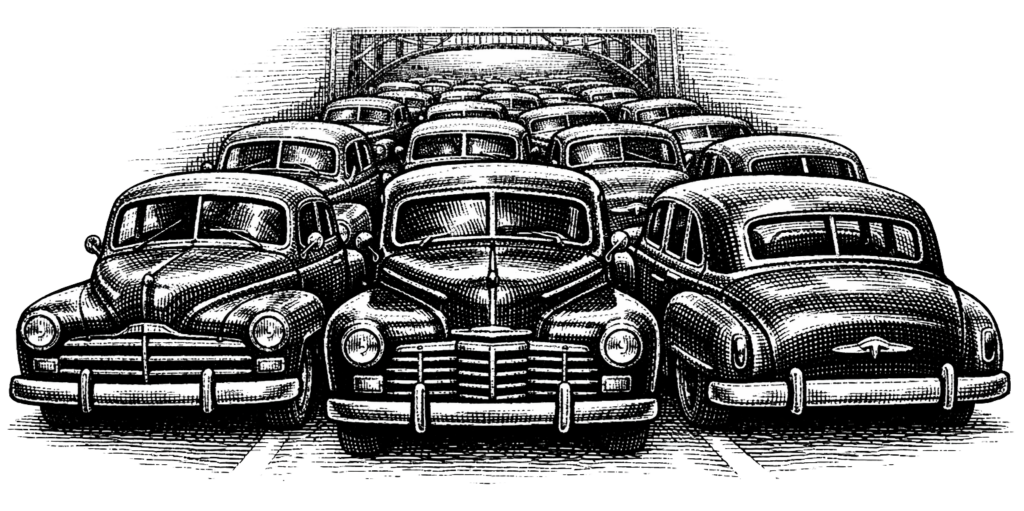
In bumper-to-bumper traffic, there is no buffer between vehicles, and the interstate grinds to a halt.
Something similar happens with humans. When our attention is saturated, there is no buffer. Only collision.
We face a constant sequence of inputs competing for our attention. It’s not just about screens. Earbuds deliver a constant stream of audio. Display advertising on roads and in airport terminals demands to be noticed. We watch on our phones and consume content on any device, all while marketing messages try to squeeze into our lane.
Every new demand crowds something out.
Our attention never gets a chance to pause or breathe.
Defensive Responses
We respond defensively to saturation.
We switch tasks or multitask just to keep up. That’s not a strategy for success. It’s a survival response.
What is the result? Deep work becomes impossible. Fatigue sets in. We become distracted or irritable.
There’s a persistent feeling of being behind.
The devastating part is that it isn’t particular to you. Look at self-help books on how to get things done or how to concentrate. It’s widespread.
But it’s probably not your fault. This feeling of being always behind is because of the saturated system we’re immersed in. It’s not your motivation.
Why This Feels Personal (But Isn’t)
When systems overwhelm us, we blame ourselves. We internalize the stress of the system as personal inadequacy.
It feels personal because the system has no visible boundary.
We might say to ourselves, “I just can’t concentrate,” or “Something’s wrong with me.”
But it’s not like something about human wiring suddenly changed.
Our biology isn’t meaningfully different from that of our ancestors. Yet our hunter-gatherer predecessors or our agrarian forebearers never had the stimulus overload of our saturated senses.
Attention Buffers
We need buffers.
I was reminded of my time as an engineer at a General Motors plant in the 1980s and 1990s. During a building renovation, our department moved to a different part of the building. We needed new office partitions and discovered older ones in storage that could be reused by replacing the original 1970s colors with new fabric.
What we didn’t realize at the time was that the old and now refurbished partitions were five feet high instead of four.
The difference became noticeable immediately. The higher panels blocked visual interruption from co-workers in adjoining cubicles or from others walking by. There was better sound buffering. Staggered entrances to each engineer’s space cut distractions even more.
Our ability to concentrate improved. These small buffers dramatically reduced cognitive load.
The trend has been in the opposite direction. Open floor plans are promoted as increasing collaboration while often serving mainly to reduce real estate costs.
Worse, though, are modern digital environments. Constant email notifications and always-on chat services ironically reduce slack and eliminate buffers while preventing us from concentrating.
The floor space may be cheaper, but the cognitive cost has risen.
Buffers protect human attention. When they disappear, every message competes at once.
Why Trust Is What Really Matters
How does all of this overload affect trust?
Overloaded systems reject marginal messages simply to survive. Messages that don’t fit don’t just fail. They degrade trust.
If you are reaching the wrong audience, you’re damaging trust. Marketing diapers to young bachelors won’t make them admire your absorbency.
People trying to unwind or relax aren’t going to react positively to your B2B pitch at 11 p.m. on the couch. You’ll squander their trust.
When everything competes at once, people stop trusting anything.
Saturated attention doesn’t just reduce effectiveness. It erodes trust.
Trust has become the most valuable commodity in messaging.