Most growth efforts fail because organizations optimize parts of the system — leads, clicks, activity, or pipeline — while degrading the whole. This creates motion that looks like progress but actively obscures reality.
If you work in sales, you’ve probably used a CRM. It tracks contacts, interactions, and forecasts, giving managers visibility into activity.
But it can also be deceiving.
Busy dashboards feel reassuring. Motion feels like momentum. Visibility gets mistaken for effectiveness.
For managers, that data provides comfort. But dashboards invite constant checking, creating the illusion of control.
The Illusion of Improvement
With a CRM, lead tools, and AI-generated lists, activity increases. More leads. More outreach. More reports.
But those numbers don’t answer the right question: Are we contacting the right people, or just measuring motion instead of signal?
One media sales CRM platform measures “asks made” — how much business a salesperson asks for in a week. One owner told me that $10,000 in asks typically produces $1,500 in revenue.
That 15 percent close rate reveals the problem.
If you’re being measured on asking, you’ll ask, regardless of customer fit.
The metric becomes a substitute for effectiveness.
Trying harder gets rewarded even when it fails.
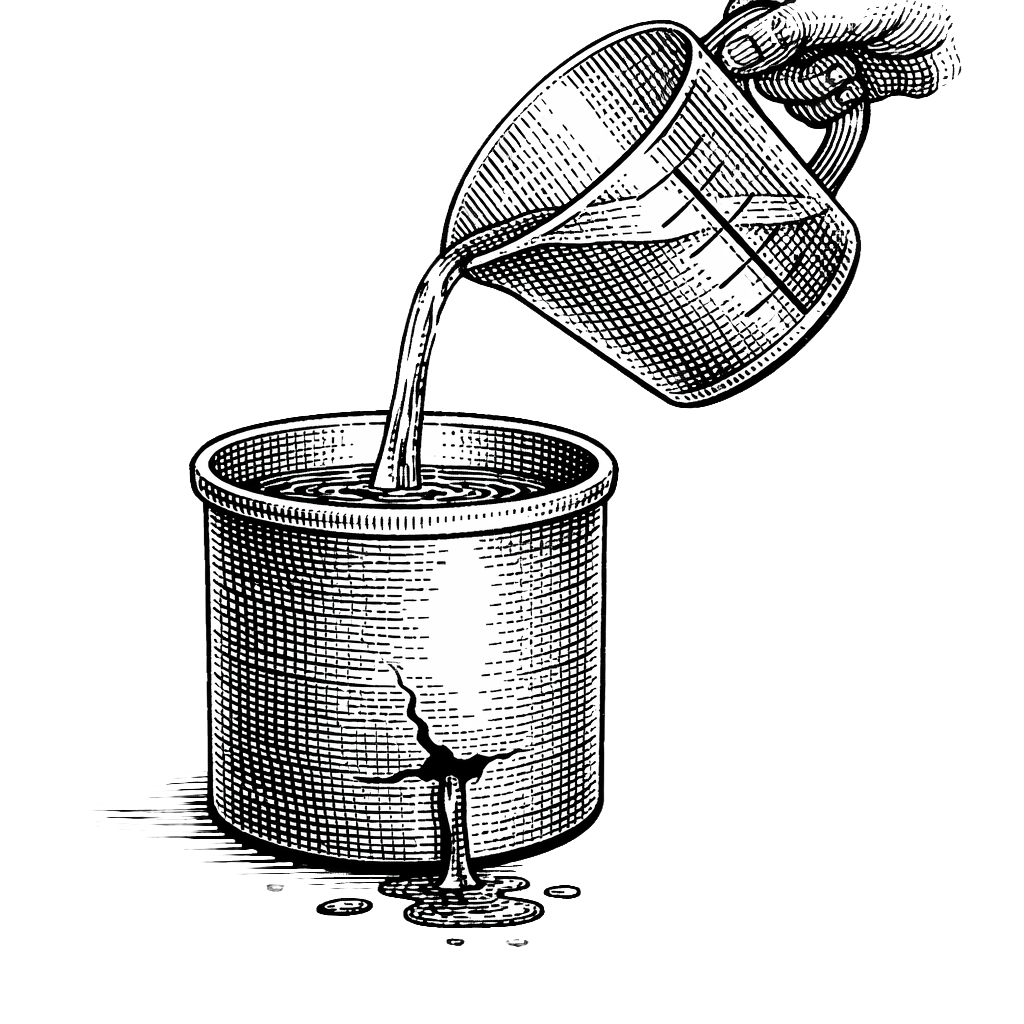
The Trap of Part Optimization
This is part optimization: improving one step of a system without reference to the constraint.
A bigger hose won’t get you more water if the nozzle is too small. A larger truck won’t haul heavier loads if the engine doesn’t have enough power.
More sales calls won’t help if they’re made to the wrong people.
More leads won’t help if they overwhelm the system’s capacity.
Optimizing a non-constraint makes the system worse.
The part improves. But the whole degrades.
Funnels as Part Optimization Machines
This shows up clearly in sales funnels.
Funnels are designed to move people through stages efficiently. But when they optimize flow instead of fit, they fill with noise.
Without strong filtering, unqualified prospects enter the system and must be removed later.
Sales teams become janitors, cleaning up preventable errors.
Human judgment gets used to repair what the system should have prevented.
Filtering After Entry Is Not Filtering
Filtering after entry isn’t filtering. It’s rework.
Once a human touches a bad lead, the cost is already incurred: time, attention, energy, opportunity.
If a human has to disqualify it, the system has already failed.
Blaming People for System Failures
W. Edwards Deming demonstrated this decades ago.
I was fortunate to see him run the Red Bead Experiment in person. Workers were praised or blamed for outcomes they couldn’t control. The system determined the result, not the individual.
Sales organizations repeat this mistake. They blame people for outcomes created by the system.
A funnel full of noise produces low close rates, and salespeople get blamed for failing.
People are punished for structural defects.
How Metrics Distort Behavior
There’s a common belief: you can’t manage what you don’t measure.
But metrics don’t just measure behavior — they shape it.
When an activity is rewarded, it increases. Calls get made. Meetings get booked. “Asks” get logged.
Whether they matter or not.
Compliance replaces judgment because people optimize for what is measured.
When metrics are misaligned, they stop revealing reality and start manufacturing it.
We’ve all seen versions of this before.
Early in my career, a colleague said something in a meeting that stuck with me. It ruffled some upper management feathers at the time.
We’re measuring with a micrometer what we’re marking with a grease pencil and cutting with a hacksaw.
The measurements looked precise. The system wasn’t.
Why Leaders Accept This
Dashboards create the feeling of control. Activity provides something to react to. Questioning the system is harder than tracking the numbers.
So leaders accept the outputs as reality.
Dashboards don’t just report the system. They protect it.
You Cannot Optimize Parts Independently
Optimizing non-constraints introduces noise.
To reduce noise, filtering must happen early — before bad inputs enter the system.
Sorting later is institutionalized waste.
Any system that cannot say no early will confuse activity for growth.
And when metrics can be satisfied without judgment, judgment disappears.